
Deep Structures for Robust Comprehension
What is robust comprehension and how do we develop it?

As I shared in my last post, SRI’s research brief on comprehension draws a distinction between “robust comprehension” and “surface-level comprehension.” According to the brief (citing Cohen et al.), surface-level or shallow comprehension results from reading to complete a task, such as answering skills-based questions (e.g., what is the main idea of this text?). Robust or deep comprehension results from reading to understand, which involves developing a literal and inferential mental model of the text.
In each case, students are reading and comprehending. But what they’re experiencing and accessing are on vastly different levels.

This isn’t to suggest that surface-level comprehension is always problematic. Literal understanding is important for accessing deeper comprehension. And there are times when superficial comprehension is all that is needed.
This ties to “standards of coherence.” Our purpose for reading establishes our expectations for whether the text will make sense. If we’re reading to skim for an answer and only need a surface level of understanding, then we don’t need to dig deep on parts that don’t make as much sense to us. But when the expectation is to deeply understand a text, if all you can access as a reader is the surface level, then there is a mismatch.
This idea of “deep” comprehension aligns with tapping into “deep” conceptual structures which exist in our long-term memory. The ability to create meaning happens at the intersection of the text and our existing knowledge. The more we’re able to access each, the more robust our comprehension becomes.
So how do we help students tap into these deep structures?
One framework I created when I was at the Louisiana Department of Education was the “Reader’s Circles.” There is one for literary texts, literary non-fiction, and informational texts. This then became the approach for most of our close reading lessons in the ELA Guidebooks.
Reader’s Circles for Literary Text
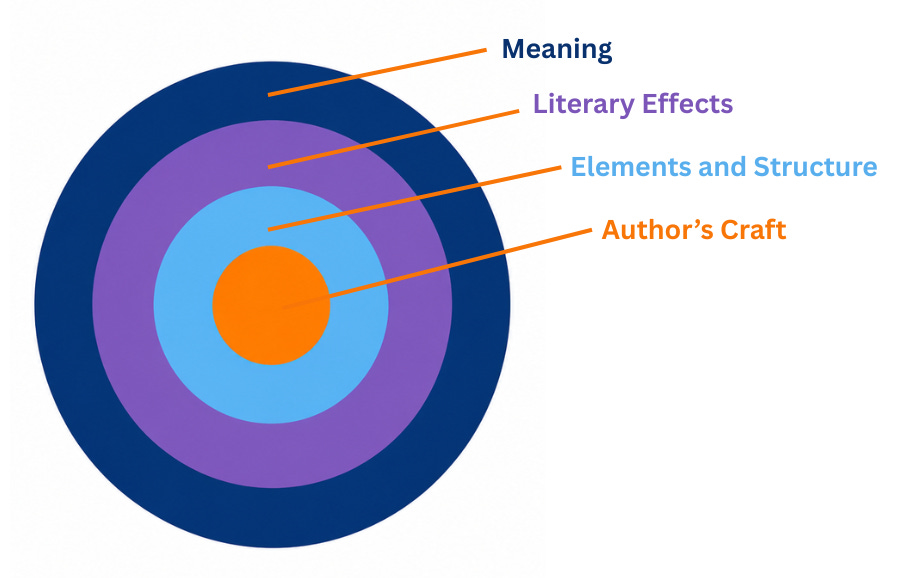
EXAMPLE COMPONENTS
Author’s Craft: Details, word choice and connotation, sentence structure, imagery, literary devices, illustrations.
Elements and Structure: Plot, pacing, setting, tone, point of view, characterization
Literary Effects: Mood, irony, symbolism, motif
Meaning: Central idea, theme, perspective, purpose
The circles framework represents reading comprehension as a cognitive process of building a coherent mental model of a text.
Let’s look at this poem as an example.
Requiem for judy the bus-driver
bigboned, and hands like frying pans
covered with those fingerless gloves.
her hair was a mass of rusty red and grey curls,
frizzy ringlets that stuck out like broken wires.
she spoke with a slight curl of her lips,
peeled back from her long horse-teeth.
baring them with each syllable.
It was always, “Now sit down and keep
your feet out of the aisle” in a
voice like a raw potato.
I lived in constant fear,
for if I left my bus-window
open in the morning,
she would track me down and
make me stay on until the end of the
afternoon run to close the rest of them.
I could not move the windows with me six-year-old hands.
Autumn was merciful, but I sweltered beside those windows,
shut fast in the spring.
Once she screamed at me for
putting finger prints on the foggy pane during snow season.
Seeing my distress, she called me sweetheart,
and kissed my cheek sloppily as
I passed by to leave the bus.
I had been crying, and her gloves
held my wet cheeks in a wool vise, turning my head
in the glare of the windshield’s reflection
to deliver the clout from her lips.

My cheeks stung with salt,
And she smelled like apples.
--Emily Madsen from the Sunken Garden Poetry Festival on www.npr.com
The narrator indicates her fear of Judy, the bus driver. Phrases such as “broken wires,” “raw potato” and “long horse-teeth” when taken together slowly establish a pattern: Judy is rough and intimidating. When, at the end of the poem, Judy attempts to show compassion to the narrator by kissing her on the cheek, the narrator describes her face being held in a vise and Judy’s kiss on her cheek as a clout (or heavy blow). These continue to show a pattern of roughness, but when the narrator says that Judy smelled like apples, there’s a contrast. Apples are sweet. This change is worth noting. If we then go back to the title of the poem: “Requiem for Judy the Bus Driver,” we can apply our existing knowledge to make connections which reveal deeper meaning. A “requiem” is related to a person’s death. While the narrator’s memories of Judy are largely tinged with fear, the last statement we’re left with is very sweet and comforting. Connecting to the inferred context and purpose of the poem (e.g., honoring Judy’s life upon her death), we can appreciate that Judy is a complicated person and that the narrator has complicated emotions related to her interactions with Judy.
So what is happening cognitively for this meaning to develop?
When we read, we first pay attention to and observe the words on the page or the surface of the text (the “Author’s Craft”). We notice patterns and contrasts among the details, which serve as the entry point for making inferences and generating new ideas not explicitly stated in the text. This forms our initial mental model of the text.
In “Requiem for Judy the Bus Driver,” this looks like noticing the words used to describe Judy over the course of the poem.
We then further build out that model by making connections across the text and to our background knowledge and experiences. This allows us to develop a more complete understanding of the characters and the setting. We might even be able to predict what will happen next in the plot.
This is why, when you read the poem, you can deduce that Judy is rough around the edges and intimidating to the child narrator.
At this point, our mental models can support processing the effects of the text. Understanding symbolism and irony, for example, require us to continue to synthesize what we know about the text with our background knowledge and experiences. In general, literary effects are inferred. They form in our minds off the page. Authors set up the conditions, but we generate the effects through the interaction of the written text with our expanding mental models. I experience these moments when I read a sentence or passage and have a lingering sense that there’s something more significant than the words on the page. I often pause to consciously think about what I just read, make connections, and let the feelings and ideas form. That “sense” is the effect that develops as I continue to cognitively process the text.
In the above poem, this happens for me on the last line. Why, if the bus driver is this frightening woman, would the narrator leave us with the image of her smelling like apples? This contrast in the description of Judy creates a subtle irony. When I then draw on my conceptual understanding of apples—they’re sweet, apple pie is warm and wholesome, they are desired (Biblical allusion)—then meaning not written on the page begins to form. That starts to get at robust comprehension.
This ongoing process of mental model creation generates meaning. This is where we begin to grasp the “so what” of the text, which is largely the result of noticing and interpreting patterns and contrasts and making connections across the various details and our knowledge and experiences. As we process the text in our working memories, our mental models become more coherent and meaningful. Our models also generate new knowledge about words, the world, and ourselves, and we move that knowledge into our long-term memory by either adjusting or adding to our schemas.
With “Requiem for Judy the Bus Driver,” I now understand the meaning more deeply. The narrator has bittersweet memories of Judy. While Judy was mostly frightening to the narrator in the moment, the narrator, presumably now looking back on those memories, can recall sweetness and comfort beneath Judy’s rough exterior. This poem reveals that adults in the lives of children, even when they play only a minor role, can have an outsized impact on their experiences.
Strong readers automatically notice these patterns and contrasts almost always outside conscious recognition. In the above example with apples, to generate meaning, I automatically and unconsciously answered these questions:
What leads to this change?
How am I to think of Judy differently?
Based on my experience and existing knowledge, what does that mean?
What does this change signify about the narrator’s impression of and/or feelings toward Judy?
Weaker readers may not immediately make those connections and need to be directed to notice them through questioning and/or conversation. This is why it’s often hard to teach comprehension because we do so much of the cognitive work in the background that we very rarely see the parts and process. For someone who struggles to comprehend when it is not related to another reading issue (e.g., weak decoding or poor reading fluency), it is likely due to insufficient background knowledge and/or the inability to make connections and inferences across the text and to prior knowledge.
Instructional Implications
If I were to teach “Requiem for Judy the Bus Driver,” I would start off with asking students their initial impressions and reflections on the poem. I want to establish an initial sense of what they are picking up on and understanding before diving in. I would then go through rounds of reading with questions and conversation to actively help students go through the process represented by the Reader’s Circles. I would start with discussing the words the narrator uses to describe Judy and encourage students to draw conclusions based on the patterns and contrasts those words establish. For example:
What words and phrases does the narrator use to describe Judy? Looking across those, what pattern is established?
What image of Judy do you have? What doesn’t seem to fit? Why? Why does the narrator choose apples? Based on your knowledge, what can apples represent?
What leads up to this contrast in how the narrator describes Judy? How does this change how you think about Judy? What does this change signify about the narrator’s impression of and/or feelings toward Judy?
I would follow that with having students look at the poem’s title and meaning of “requiem.” What might be the purpose of this poem? Despite the narrator saying she was afraid of Judy, why does the narrator write a requiem for her? What does this indicate about Judy’s impact on the narrator?
These questions work through the concepts represented by circles, actively supporting students in developing robust comprehension. The focus is on building meaning, taking the whole text into account, and analyzing the poem across multiple reads.
What I can’t predict nor control for is the knowledge that students bring to the text. If they have no concept of apples beyond them being a food you eat, it will be much harder to derive a deeper meaning of this poem. If they don’t know the meaning of “requiem” that will further confound them.
This reveals an ongoing tension in comprehension instruction. When planning for a text-based lesson, we work to figure out what questions to ask in what order, how many, how much time to spend, what answers to expect, etc. But when we’re teaching a comprehension lesson, we have to treat all of those as loose expectations. We need to be able to respond to student thinking live and see where it goes. This requires us to work through text in conversation and collaboration with students. Of course, in a classroom of 30 kids, that seems almost impossible, especially if we’re to honor each student’s individual meaning making process.
The Reader’s Circles, then, can be a useful framework that students can adopt to develop these habits of thought. The more students practice recognizing the deep structures of texts, the more naturally they begin to approach reading complex texts in this way. Unfortunately this doesn’t address all potential obstacles, as insufficient background knowledge can still create issues with robust comprehension. That’s why it is especially important that what I read with students is doing both: building knowledge about words, the world, and themselves AND helping them parse complex texts.
What is typical of many classrooms and curricula, though, is to focus on skills as a way to develop comprehension. This kind of instruction might involve a set of questions like this:
What image best depicts Judy as a rough woman?
Why is the narrator scared of Judy?
What events lead up to the narrator’s distress in line 22?
What is a “vise”?
How does Judy comfort the narrator?
Why does Judy comfort the narrator?
What is a theme of this poem?
A “requiem” is often used as a way to honor someone when they die. Why might the narrator want to remember Judy following her death?
What’s the difference with this set of questions and the ones I suggested asking?
These questions often take the thinking away from students. Students are merely expected to hunt and peck for evidence to support the thinking expressed in the question.
The goal of answering these questions is to demonstrate skills aligned to standards.
While the skills addressed by these questions might relate to comprehension, there is no focus on students generating a coherent mental model of the text. As a result, comprehension remains out of reach, secondary, an afterthought. (While I might be able to recognize and play chords on a guitar or piano, that doesn’t mean that I can successfully play a whole song which combines those chords together with timing and rhythm and musicality.)
There’s also a mistaken assumption that practicing these skills with this poem will then magically transfer to another text.
The implications here are that we need to design sets of questions with complex texts that walk students through a process and reveal and model that process for them. This exposes students to the deep structures of texts. Read more about this design concept in my post “What Produces Answers.”
Comprehension is a creative cognitive act. The text creates the conditions upon which we can generate meaning, but we have to bring our thinking and our knowledge and experiences to bear.
This description from Life is in the Transitions by Bruce Feiler describes a process of transition in life, but I think it also beautifully describes what happens in our brains when we generate meaning as we read a text.
“The essence of chaos is self-organizing. It’s what a river current does when it eddies around a boulder and then reforms; it’s what a flock of birds does when it takes off from a tree and then glides into formation; it’s what a weather system does when it collides into a different system, merges, and then keeps moving; the same with sand dunes, snow squalls, clouds. In all these cases, the original entity begins in one shape, goes through a period of turbulence, a kind of mini–state of chaos, and then emerges with a new shape, both substantially similar to the prior state and wholly different at the same time. Chaos is nature’s creativity in the face of constant change.”
As we read a text, it starts as words and details and ideas. Our brains then process those in the context of our existing knowledge to produce meaning. That meaning is both reflected in and made possible by the original text, but it is also wholly individual and personal to each reader.
The Reader’s Circles provide a framework to represent this meaning creation. They are a Rosetta Stone to help translate complex texts and unlock access to more robust comprehension.