
The Case for Writing
Why teaching writing is more important now because of AI


When we talk about ELA instruction, our focus is almost exclusively on reading. While we expect students to write, we often leave it up to chance—we assign more writing than we teach it. It’s typically a means to an end. We often assess writing summatively because it is one of the most common ways to assess reading outside of multiple-choice questions. Since students are writing, we go ahead and assess the writing, too, even as strong or weak writing scores do not impact the system much (for better or for worse). Most writing assessments are costly to administer and score and take a long time. Grading writing in the classroom can be overwhelming, so teachers often skip the writing portion of their curriculum or assessments. Writing is also hard to teach, particularly if teachers are naturally good at it. While there have been many efforts over the years to help bolster the importance of writing (see Writing Resources below), writing remains in reading’s shadow.
AI presents both a threat and an opportunity. If AI can write for us, what’s the point of learning how to? Why do we need to be strong writers? What value does it provide? We also need to loosen up our assumption that strong writing means strong reading comprehension. It is possible to have robust and sophisticated thoughts and not be able to express those in writing. With AI outsourcing, it is now possible to generate polished writing without any thoughts.
It’s time we sound the alarm on writing: now is the time to commit to writing and repurpose its role in the classroom before AI cannibalizes it.
I (Whitney) have many core memories of writing. I have always been a good writer. I won awards as early as kindergarten for my writing. I attended a young author’s conference in second grade. When I entered junior high and started to write analytical essays, though, I largely stopped writing creatively and for fun. My mom was often my editor. She would read through my papers and offer suggestions. Before we had a computer, she would also type my papers on our electronic typewriter. I learned a lot about structure and grammar from my mom. In my freshman year of high school, I got a less than stellar grade on an essay I wrote. My teacher told me that I needed a thesis. When I asked her what that meant, she was unable to give me a definition or example. I asked my mom, and she was at a loss. I looked up “thesis” in the dictionary (this was before the internet). It started with a dissertation for graduate and doctoral degrees. As I scanned down to see “a statement that introduces the main idea of a written work,” I still did not know what that meant in practice. So I anguished over what a “thesis” was and was nervous to write another essay without this seemingly fundamental aspect of writing.
When it was time for our midterm exams, I called one of my friends who took the exam the day before me. I asked her what the essay topic was, what she wrote about, and how she put it together. She said, “I restated the prompt and then said, ‘for two reasons: 1 and 2.’ I then wrote about reason 1 and then wrote about reason 2.” When it came time for me to write my essay, I followed her advice, giving my own reasons. At the beginning of the next semester, my teacher said to me, “Congratulations, Whitney! You finally figured out a thesis.”
The moral of this story for me: models are tremendously important.
Unfortunately, I didn’t learn that lesson right away as a teacher. I struggled to teach writing well. It was very performative. I taught the “hamburger method.” It wasn’t until I was selected to serve on a Louisiana statewide assessment writing rangefinding committee that I realized how much understanding quality in writing was something to be done in community with others. This fundamentally changed how I taught writing.
I (Molly) remember a steep uphill journey to becoming a comfortable and confident writer. Whenever teachers would ask us to write, even if it was a quick stop and jot, I slogged through it. It was my most dreaded part of any lesson. Writing seemed to have a set of rules that were out of reach for me. Whether it was where to place a comma or how to write a 5-paragraph essay, there was a code I simply couldn’t crack. Because it felt untenable, I stopped trying to crack the code and instead made up my own. I resolved to sprinkle in commas and generally approached writing as a stream of consciousness endeavor. It wasn’t until my senior year of high school and early college that things finally started to click. My ELA teacher gave me regular feedback on my writing. She read every word I wrote and annotated my essays with specific and concrete suggestions for where to improve. Her margin notes helped me start to connect the conventions of writing to my own use of language and clear strengths and gaps in my approach emerged. While in college, I had a roommate who generously and regularly read my writing assignments and offered that same type of specific feedback. It helped me start to see the value of concision and clarity in word choice as well as the power of a well-crafted and grammatically correct sentence and paragraph.
Eventually frequent and specific feedback helped me connect those rules to my own practice. Feedback helped me make connections between my own practice and the rules that govern strong writing in a way I had not been able to do previously. Specific feedback acted like a decoder ring: it helped me connect abstract rules to concrete choices I was making on the page. Instead of hearing, “Your transitions are weak,” I learned what effective transitions actually looked and sounded like in my own writing. The rules only became useful when feedback linked them to my own work.
What is Writing?
There are three components which come together to create strong writing: 1.) Ideas (Content and Structure) 2.) Style and Voice and 3.) Grammar and Spelling.
What’s on the surface is the code. What sits behind it are the ideas. The code includes the structure of the writing and the grammar. These ideas are what those words, sentences, and paragraphs mean. This means that students must have knowledge and understanding of a text or topic and students must be able to express their understanding clearly and coherently.
Writing can be both informal and formal. Informally, it is a way to offload thoughts while learning to reduce cognitive load. When we jot down ideas, take notes, and complete graphic organizers, we externalize our thoughts, freeing up brain space to process more complex ideas. Formally, writing is a way to express understanding, document claims, and contribute to a larger academic conversation about topics and ideas.
In “Stop Defining Understanding,” Whitney wrote about how language is an agreement among humans. We all agree that particular words have meaning and we agree on that meaning. Language is codified thought. Language makes certain thoughts easier and more shareable. Even as we can think of a thing for which we have no words to describe it, without language we are limited in ways to share it.
Over time, we have developed written language in addition to spoken language to communicate with others. In the 15th century, the printing press democratized access to texts. Once we could print written texts at scale, it paved the way for reading and writing to become an activity that everyone could do. While widespread literacy didn’t happen until much later, the technology of the printing press was a needed step in evolution. Texts were no longer reserved for the rich who could afford them, the erudite who studied them, and the religious who interpreted them for others.
Why Should We Teach Writing?
Writing is a way to connect with others. As Whitney shared in “Learning is Not a System” and “What Produces Answers,” Yuval Noah Harari theorizes that what allowed humans to advance as a species is our ability to believe in shared stories. In Together by Vivek Murthy, he speaks to a similar idea. He suggests that stories create community, a sense of belonging. He says that what brings us together is our ability to share stories, which represent our knowledge and emotions: “We’re wired to associate belonging with the sharing of stories, feelings, memories, and concerns” (p. 32).
This idea of shared stories allows us to work together. It enables empathy. When two distinct human beings with different brains interact, language connects us. It can also divide us: think Tower of Babel.
With few exceptions, we develop oral language without direct teaching. It’s something our brains have evolved to do. We don’t, however, learn how to decode (read) nor encode (write) language without direct teaching.
How Should We Teach Writing?
If writing is both a tool for thinking and a means of communicating ideas to others, then students need opportunities to see quality, practice regularly, receive feedback, and revise their thinking over time.
We can and should teach at both the macro and micro levels. Macro is a complete composition. Micro is the individual words and sentences. Students can be taught at both levels, and they should in various ways. We have to operate at both levels thoughtfully in a classroom. We also need to incorporate both informal and formal writing opportunities and teach students how to do both well.
Approaches such as The Writing Revolution, Quill, and The Writing Pathway support teachers in teaching writing at the micro level, working toward the macro level. They also incorporate many tasks which can be used informally and formally. Sentence stems, sentence composing, and mentor sentences (writing focus and combined reading and writing focus) are also strong ways to build micro writing skills. And, while there is a progression of writing skills that build on each other and can be observed and directly taught, it’s important that those skills are applied to expressing thinking about texts.
We take up words we hear. We adopt grammatical structures from our community. Think of Gen Z slang. Our language is a copy of what we’re exposed to. Learning to write, then, in theory is an act of copying. What makes each composition unique are the ideas we communicate. When we write we’re expected to follow agreed-upon criteria. We learn that criteria from being taught rules and seeing those rules applied in examples.
As described in our personal histories, what was most impactful for our writing development was directed feedback from a mentor—someone we believe is knowledgeable about writing and we trust to offer help. In classrooms, that might be the teacher or a peer, but what is common is that the writing process is not done in isolation.
Teachers should instruct writing regularly, daily really. They should be providing feedback to students as they are writing with the goal of improving their writing. The value students get from writing is the ongoing practice with directed feedback and followed by revision.
Anytime students wrote in Whitney’s class, they did it in class. Her writing instruction included four key components:
Models and exemplars
Timely feedback during writing
Student rangefinding and scoring
Revision based on common criteria and specific feedback
Whitney would provide lots of models before students started writing, and she would talk about expectations before students started to write. She would also read over her students’ shoulders and remind them of the models. When they would submit their “final” version, whether short answer or essay, she would read or at least heavily skim it and immediately conference with them: Why did they choose that detail? Look at this sentence again and read it out loud—does it make sense?
Whitney did have the luxury of having her students for 90 minutes every day, which gave her the time to spend this way. As she described in her personal history, the one thing that really changed the direction of her writing instruction was that students became scorers. Whitney would have her students engage in a writing rangefinding and scoring activity. The purpose of this was to help them recognize and internalize criteria for quality and see it applied in models/examples.
I would provide exemplars and non-exemplars writing for the prompt. (Anchor Set)
We would then discuss each model, what was strong and what needed improvement and why based on the scoring rubric.
Then students would write.
Once they submitted their first draft, I would put students in groups and have them review more writing samples for the writing prompt and score them against the rubric. (Scoring Set)
For each scored essay, they had to explain their rationale.
We would also discuss it as a class.
Then students would share their draft and talk about an initial score with their group.
Then they would revise their writing on their own.
Writing Rangefinding and Scoring Example
The added benefit of students scoring their own writing is that they got immediate feedback from peers and the grading process was more about confirming a score, which made it much faster.
Writing was an artifact of their thinking, their conversations, and the tasks. It was not an “assessment” in a vacuum.
Students should be writing almost daily, but we don’t think teachers should “assess” writing in the traditional sense very often, maybe only 1-2 times in a 6 week period using the writing tasks embedded within the curriculum. Even so, as a signal, writing assessments do help prioritize writing instruction. We inspect what we expect.
Teaching writing can and should be a very iterative and community-driven process. The idea that we need students to craft their essays entirely alone with no examples to start or else it’s not a good assessment of their learning is a misconception. We decide criteria for quality in community with others. Since writing is how we codify our language agreements, when we write, we have to understand what we want to say and how to communicate that to others. Languages, like the humans who use it, evolve. While there are rules we follow, these also change over time. For example, ending a sentence with a preposition was once seen as an error. Now it sounds weird to follow the rule (e.g., compare “There are many choices from which to select” to “There are many choices to select from”).
In writing, there are ranges based on context and purpose rather than exact answers. If you’re writing poetry or prose, style can be a personal opinion. If you’re writing for a peer-reviewed journal, the ranges of acceptability are defined by the expert community of the academic discipline. That’s why we have MLA and APA and Chicago Manual of Style. There are more opinions than standardized quality, no matter what grammar enthusiasts want to tell you!
Since writing communicates ideas with others, we also have to consider our audience and their knowledge and expectations. It is not helpful to have students write something for the teacher alone.
What Can AI’s Role be in Teaching Writing?
Learning to read and write, whether that writing be words or numbers, is fundamental to all learning. We read to gain knowledge of words, the world, ourselves and others. We write to share that knowledge. This is where AI becomes potentially problematic. Whose knowledge is being shared? While the printing press sped up the creation of texts, allowing for mass production, the knowledge and ideas shared were purely human and presumably original. We run a high risk of outsourcing our thought to AI, but we can also learn how to work with AI to ensure it remains a tool to speed up the creation of writing rather than a replacement for thinking.
As Whitney shares in her interview on her book chapter for AI Everywhere, we need to consider whether learners possess the foundational skills that AI is using and the ability to conceptualize or model the deep structure of the ideas without AI. Can they look at what the AI tool does and determine whether it is quality? If not, then using AI to write and create for them feels too premature—it’s in the territory of outsourcing.
That said, AI can still be useful for improving our writing ability. If writing is just about producing a product or getting a passing score, then it will become an AI-only activity. But if students view writing as a way to share knowledge, and it is taught as a process and a tool for offloading thoughts rather than a performance or a product, students may be more willing to practice writing. That practice and trial and error are how we get better at it, and it acknowledges that thoughts don’t instantly appear, rather they are developed over time with continual attention and deliberation. If the work of writing is less about the finished product and more about the process of getting there, then AI tools have a much different role to play, which could even be helpful for offloading rather than outsourcing thinking. Instead of having AI write for students, AI can be a thought partner and simulated community.
Here are some ways that we may use AI in the writing process to support student writing rather than writing for students.
AI as prompt translator: Give the writing prompt to AI, and ask what the prompt is asking you to write about. Then ask it to help you break down what you’re supposed to do in your response.
AI as model generator: Give the writing prompt to AI, and ask what a well-written response would look like. Identify what you think makes it a good response and then check your thoughts with AI. Then ask AI to provide a set of criteria to consider when you write your own response.
AI as quality criteria generator: Give the writing prompt and an exemplar response (if you have one) to AI. Ask it to identify a set of criteria against which you can evaluate your own writing.
AI as writing stem generator: Give the writing prompt to AI, and ask it to provide you with some sentence stems for sophisticated sentences that you can then use to craft sentences for your response.
AI as productive contrarian: Give your initial thoughts from your response to Ai. Then ask AI how someone who disagrees with you may question your thinking: What am I not seeing? Where are my blind spots?
AI as a “peer” editor: Give your first draft to AI, and ask it to summarize the main points. Check whether those points align with what you believe are your main points. Then ask AI to identify which of your points are well supported and where you could use more support and why.
AI as copy editor: Give your “final” draft to AI, and ask it to help you finalize your essay. Instead of having it rewrite your essay for you, which it may naturally do if you don’t specifically tell it not to, ask the AI to give you a checklist of edits to make. If it is hard to understand what it is referring to, then you can ask it to rewrite a sentence or paragraph to show you how to make the edit. Always be sure to verify that the change improves your writing. Do not accept all edits as necessary!
Not everyone will want to or will need to use AI. Some may need to use it more often. In Whitney’s personal history, AI could have given her samples of thesis statements and explained how they function in a written text, similar to her friend but without the cheating. We even used AI as a copy editor for this post.
Coincidentally, Molly attended a conference this week hosted by a state-level education organization, and this slide came up:
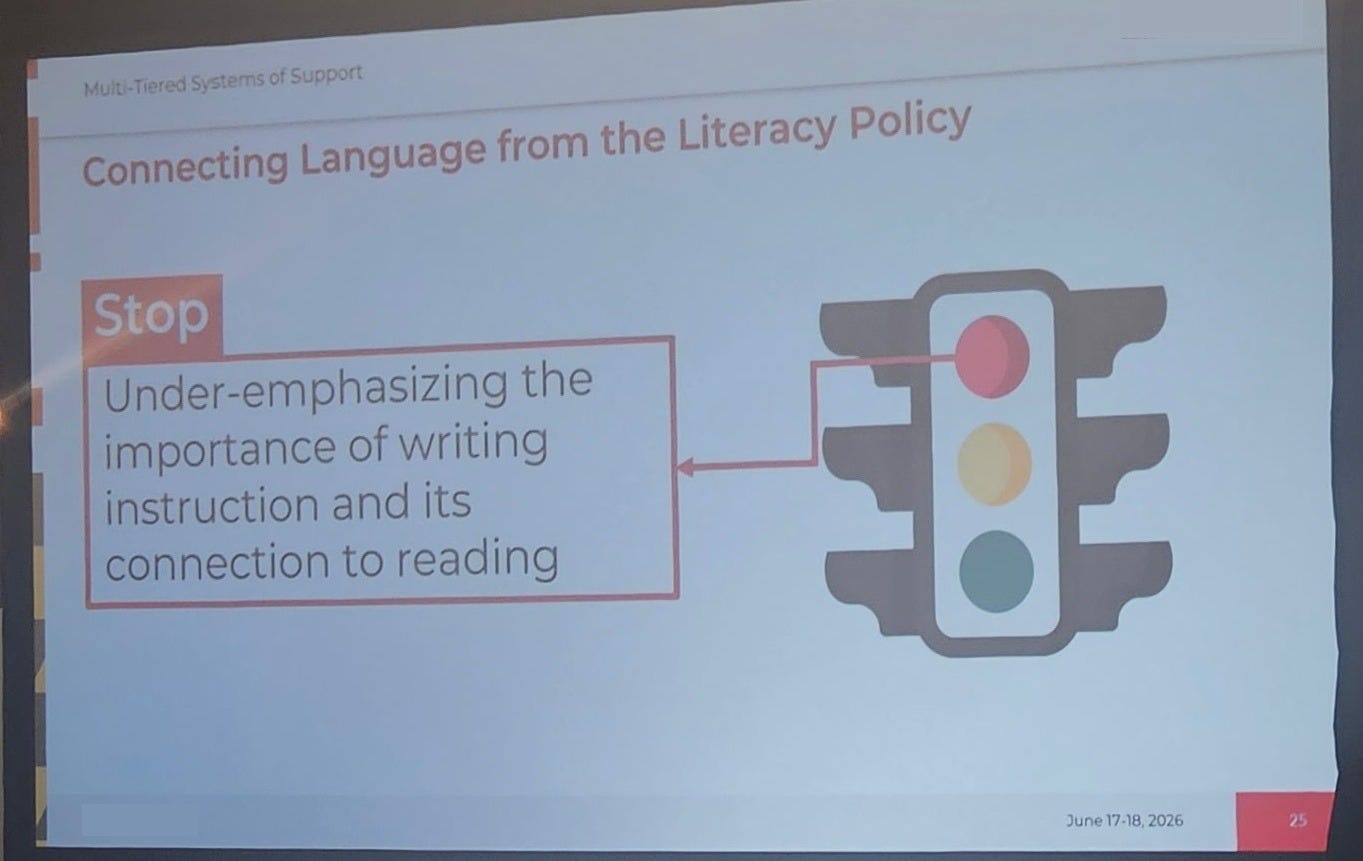
Schools and teachers face a litany of complex challenges, and we can now add in AI. While AI can generate written responses, we shouldn’t let it replace the process of developing, refining, and communicating ideas with others. We must treat writing as more than a product, and we’ve presented several ideas for how schools and teachers can realistically do this. Once we repurpose our instruction to show how writing is a tool for thinking and participating in a community of ideas, it will become a critical piece in our push to engage students in deeper comprehension work. In the end, while reading may get most of our instructional attention, writing is where students’ thinking becomes visible, so we must prioritize it accordingly.
Writing Resources
Natalie Wexler’s latest work: Beyond the Science of Reading and Season 3 of The Knowledge Matters Podcast
Vermont Writing Collaborative: Writing for Understanding
Steve Graham’s work: ”Writing Next” (2007)
Kelly Gallagher’s work: Write Like This
“They Say / I Say”: The Moves That Matter in Academic Writing, Gerald Graff and Cathy Birkenstein
Don and Jenny Killgallon: Sentence Composing
Image Grammar, Harry Noden
Teacher’s Guide to Effective Sentence Writing, Bruce Saddler
Jeff Anderson: The Write Guy
 | A guest post by
|